The Devil Wears Prada 2 Isn’t a Movie - It’s a Masterclass (and Warning) in Brand Partnerships
If the original The Devil Wears Prada gave us a front-row seat to the fashion industry, the sequel is giving us something else entirely: A front-row seat to the future of brand partnerships in entertainment. And if you work in marketing, media, or sponsorships… you should absolutely be paying attention. Because this isn’t just product placement anymore. This is IP as a full-blown commerce engine.
Let’s get into the hot takes.
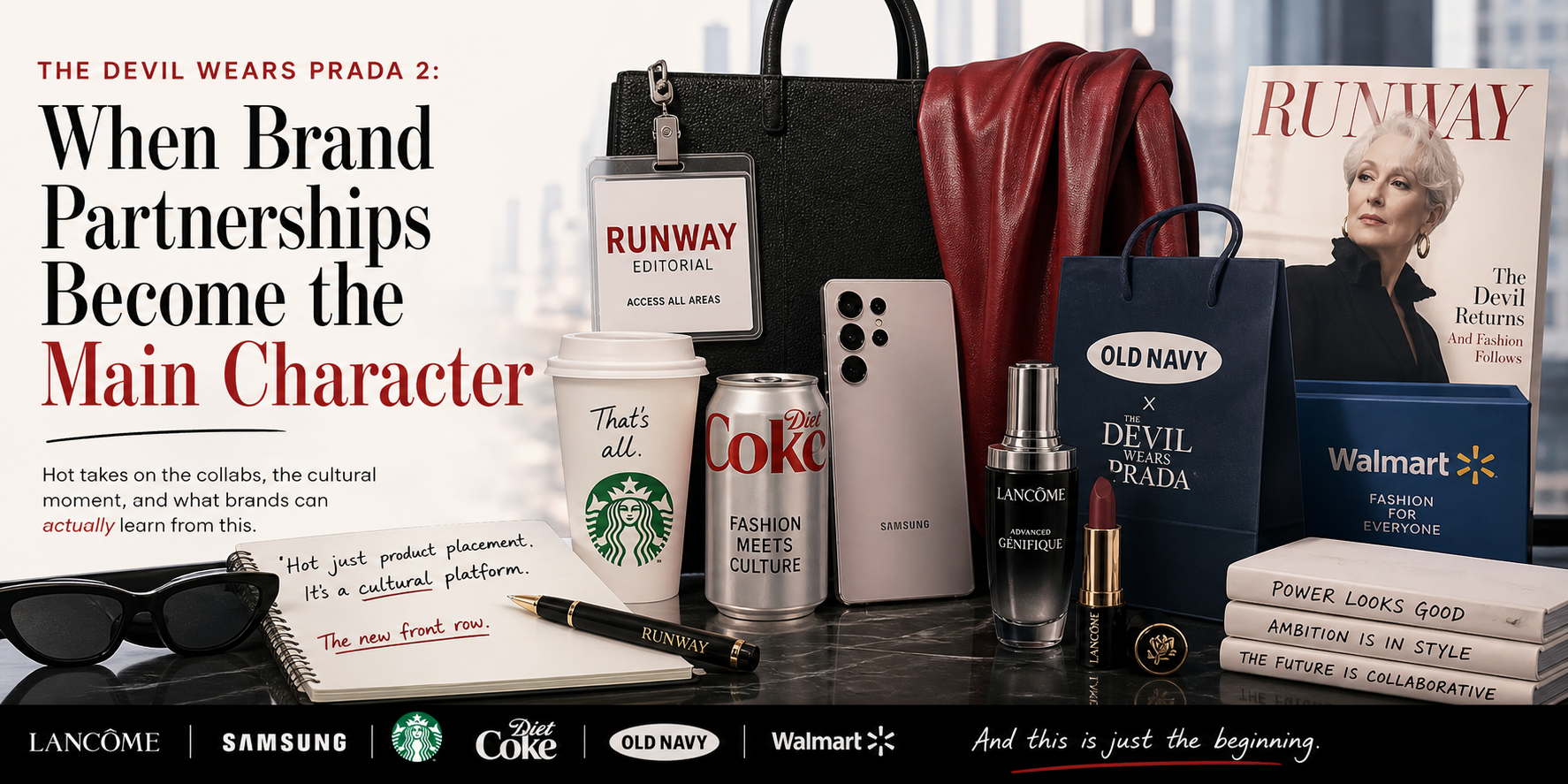
1. This Isn’t Product Placement—It’s a Brand Ecosystem
The sequel has pulled in partners across:
Beauty (L’Oréal / Lancôme)
Tech (Samsung)
QSR (Starbucks)
Retail (Walmart, Old Navy)
Beverage (Diet Coke)
That’s not a sponsor list—that’s a media plan.
We’re seeing everything:
In-film integrations (beauty products used on screen)
Co-branded retail collections (Old Navy capsule drops)
Menu tie-ins (Starbucks drinks inspired by the film)
Custom packaging (Diet Coke leaning into “fashion meets culture”)
Studios aren’t just selling placements—they’re selling platforms.
2. Everyone Tried to Copy Barbie… But Missed the Point
After Barbie, every brand wants in on a cultural moment. But here’s the difference:
Barbie partnerships felt cohesive, curated, and intentional
Devil Wears Prada 2 sometimes feels like… everyone got a yes
Yes, there are a lot of partnerships. But not all of them ladder up to a clear, unified story. When everything is “on brand,” nothing really stands out.
3. Luxury Took a Backseat to Accessibility, On Purpose
This might be the most interesting strategic choice. Instead of leaning fully into high fashion, the partnership mix includes:
Walmart collections (I REPEAT: WALMART)
Old Navy apparel
Drugstore beauty integrations
Starbucks menu moments
That’s not accidental. It’s a shift from: aspirational luxury → participatory culture. The message is no longer “you can’t sit with us.” It’s “everyone can play.” Smart for scale? Yes. But it also softens the edge that made the original film iconic.
4. The Real Product Isn’t Fashion, It’s Power
Let’s be honest: Brands didn’t sign up for this movie because of handbags. They signed up for Miranda Priestly energy. Miranda Priestly represents authority, confidence, ambition, and transformation.
That’s why beauty brands, in particular, are going big. Because they’re not selling lipstick—they’re selling: “This is what you look like when you’re in charge.”
5. We’ve Officially Entered the Era of Content-Commerce
Some of the smartest partnerships blur the line between storytelling, advertising, and retail.
Lancôme products integrated directly into scenes
Samsung devices solving actual character problems
Fashion and beauty tied to immediate retail drops
You’re not just watching the movie. You’re shopping it—sometimes in real time. The funnel is gone. Content is the conversion layer.
6. The Irony Is Kind of Perfect
The original The Devil Wears Prada was, in many ways, a critique of consumerism and the fashion machine. The sequel? Fully powered by it. Brands that once might have hesitated are now lining up to be included.
It went from: satire of the system → centerpiece of the system, and honestly… Miranda would approve.
7. The IP Is the Real Influencer
Here’s what’s fascinating. No single brand is “winning” this partnership wave, because the real winner is the franchise itself. The Devil Wears Prada 2 has become:
the distribution channel
the cultural moment
the endorsement layer
Brands aren’t elevating the film. The film is elevating all of them at once.
8. The Miss: Not Enough Taste for a Movie About Taste
For a story rooted in editorial judgment and curation…Some of the partnerships feel a little un-edited. There’s a version of this where:
fewer brands participate
each one is more premium
every activation feels “Runway-approved”
Instead, it can feel like “Yes to everything” vs. “That’s all.” And that’s a missed opportunity.
9. The Best Brands Didn’t Sponsor the Movie—They Joined It
The smartest executions don’t feel like ads at all. They feel like extensions of the world.
Starbucks creating drinks that feel like they belong in the Runway office
Samsung naturally embedded into character behavior
Beauty brands integrated into transformation moments
The lesson: Don’t just attach your logo. Write yourself into the script.
Final Take: This Is the Future—Whether We Like It or Not
The Devil Wears Prada 2 is both a playbook for modern brand partnerships and a warning about over-commercialization. It proves that:
IP can drive massive cross-category revenue
entertainment can function as a full-funnel marketing engine
brands will pay to be part of culture, not just advertise around it
But it also raises the question: At what point does the partnership become the product? And more importantly… Would Miranda call this groundbreaking? Or just… cerulean?